This is the story of a love affair. I'm not absolutely sure that we always recognise love - not even when it is left on a plate in front of us, so to speak - and when you are only six or seven.... well!
HELLO SWEETIE!
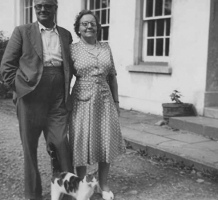
(The picture is of my grandparents - and cat - outside Aunt Jessie's house.)
------- o -------
'Hello, sweetie!' she would say.
Behind her glasses there was a lovely twinkle in her eye. I was too young to recognise what it meant.
Touch wood, when I was young I never had the feeling there was anything about my body that displeased me: When I was young! it didn't matter much how it performed - just as long as there wasn't blood issuing forth. All kids are the same about blood in my experience: a scrape or a fall is tolerable, just as long as when you look at where it hurts there is no sign of the red stuff.
She, on the other hand, had a definite reason to complain. Yet she didn't.
I can hear her now, 'Come and sit by yer... ' she'd say and then pat the counterpane beside a chair which was permanently alongside her bed.
That is the point of this wonderment I have about her. I can remember her voice saying those two words almost as if she is in the room with me now: its lilting Welsh accent - the valley accent they called it, back there, where much of my family come from. But it was more than that, because it was her voice.
You see, I can't classify my memory as being something of my body. It can't be seen, and comparisons about it can only be made subjectively, but I have to confess it is something which has displeased me: Largely, because it hasn't seemed good enough.
In my mind's eye, I'm confused about the layout of her cottage. This is because I was to gain intimate knowledge of that cottage many years later. Today, to get to where her bed was, you would enter through the kitchen door, and move on into the only other downstairs room to the left - the one with the staircase in it - and there, tucked neatly beside the narrow flight of steps, was her single bed. But in my mind's eye, back then, the front door did not lead into the kitchen. Instead, it led directly to her bed. Sadly, there is no one left alive who could verify that it has, or has not, been changed.
So what of this wonderment, then?
She smelled of home. It was a warm, sugary, creamy-soft smell. Perhaps there was a hint of vanilla in her perfume? If I didn't know better, I would have said that it was a very motherly smell. And she always seemed ... soft. Yes, I know that these are hardly picture forming descriptions, but they are the ones that are painted indelibly in my memory.
The sense of softness about her, is highlighted for me by the fact I always seem to remember her wearing a soft, pink, knitted, fluffy bed jacket. The jacket was worn over an equally soft nightdress which today I'd guess was made from brushed cotton. Soft.
Her illness made her painfully thin. Her frail wrists, appearing pale and sinewy from under the sleeves of her nightdress. And she had soft, gentle hands, with very long, perfectly manicured, artistic looking fingers; fingers that would hold a book, or my hand, as if it were the most fragile and important thing in the whole wide world.
I remember it was my dad who taught me the importance of hands. His were well manicured. He showed me how to push back the quicks at the bed of the nails with a thumbnail. It used to hurt. Still does. But he instilled in me that it was an important part of grooming. For most of my adult life people have remarked about my hands, or my nails, which are a shade longer than the average man's and I like to think fairly well manicured ... but nowhere near as well as hers of course.
For a young boy of six or seven, having any female wanting to give you a kiss, was to be endured only under duress. Like the kiss of Aunt Lizzie, with her whiskers tickling the side of your cheek. Aunt Lizzie's kiss was the worst of all! Good manners told you to only wipe the cold and wet area left behind on your cheek with your sleeve when you were well out of her sight!
When Miss Colebrook kissed me however, there was need for much more compliance, much more cooperation, because she being bed-ridden and fairly immobile, it was necessary for me to do almost all of the work of getting close enough; stretching over the edge of her bed and manoeuvering my cheek towards her lips. And, wonderment again, I didn't shrink away from her. Far from it. I actually found her Hello and Goodbye kisses as enjoyable a part of visiting her as was our shared love of reading. She was so soft and gentle.
Though I didn't realise it then, I loved her. And what I didn't recognise, all those years ago, through the eyes of a young child, was that the twinkle in her eyes was a sign that she loved me too.
'Can I go and play with Miss Colebrook?' I would ask.
Sometimes the answer was an immediate affirmative, but more often I was made to wait around while she was made ready for her day. I don't remember if she had a nurse who visited, or whether some neighbour aided her. A child doesn't ever think of the practicalities of such a life as hers. I would simply sit down, near our door, ready for a quick escape when the time to go to her came - and I'd impatiently start turning the pages of a book that I planned we would both read; not actually reading anything, sometimes just moving ahead through the story to a point where there was an illustration of some kind or another, and then quickly closing its pages for fear of learning something of the story out of place.
My great-aunt Jessie's house was like a magnet to my grandparents; it was where we would stay when they took their annual, or more often biannual, trips back 'home' to the valleys. They weren't particularly memorable to me for their fabled greenness. What I remember most, was my fascination for the great buckets of slag that swung from overhead cables, their contents moving ever upwards from the coal mines, destined to be spilled high up at the very peak of the enormous grey slag heaps that overshadowed everything as we approached our village. I would look out for those overhead cableways as we neared our destination, they told me that we would soon be there, and that maybe we'd be in time to go see Miss Colebrook before tea. Her cottage was next door to aunt Jessie's house.
Was it by magic, that when I arrived by her bedside, she would have some book or story ready to grab my interest? No doubt at some point Aunt Jessie would have told her of our imminent arrival.
I don't remember the passing of Miss Colebrook. It must, of course, have happened when I was back in London. No one ever told me she was gone. Maybe this was the adults' way of sparing me any grief for the loss of someone special? She simply was never there again. Never there to read to me, never there to kiss me hello or goodbye.
To some extent, after her demise, aunt Jessie became the focal point of my visits to the Rhondda. She had been the headmistress of the village school, and had specialised in art. So there were always paints, paper and brightly coloured crayons available. Her love was harder than Miss Colebrook's. Aunt Jessie could freeze you solid with one of her well practised stares. But, underneath her stern exterior, there lay a heart that truly loved children.
The change in those visits was mirrored by the fact that, inevitably, I changed too. I was growing up. I began to prefer the company of my mates during school breaks, and I seem to recall a girlfriend or two whose existence helped sway me from missing out on trips back to the valleys.
It was a very, very long time before I returned. It was after my father died, and it was prompted by a peculiar twist of fate: one where my mother moved back to that village - and bought what had been Miss Colebrook's cottage!
Aunt Jessie still lived in the big house next door and, when my wife and I visited my mother, our own two daughters were the ones asking if they could go to play with someone. That someone, was great-Aunt Jessie. She still had copious supplies of art material with which to entertain enquiring young minds.
When I first wrote this piece in 2005, I had been reading a biography - "Rachel Sarai's Vinyard" by Deborah Rey - and in it, set in wartime Holland, the central character discovered who her real mother had been - but only after years and years of being brought up by a sadistic pseudo-mother. As a very young child she had, for a while, experienced a loving relationship with a woman, though it was not until some thirty years after that particular woman's death, that she discovered the truth that that woman had in fact been her real mother!
In some strange way I was able to emphathise with the character in that biography. If not for my relationship with Miss Colebrook, I would never have known what that might have felt like.
© Griffonner 2026
Words by Griffonner

Read 296 times
Written on 2026-04-10 at 11:59
Tags Nostalgia Childhood Love
 Save as a bookmark (requires login) Write a comment (requires login) Send as email (requires login) Print text

|
Melinda K Zarate |

|
one trick pony |